
Resource Management and the PMO
New! Resource Management and the PMO
Pilot course: 5–6 October 2026
Save £225 on the first public course
House of PMO members save a further £250
Resource Management and the PMO
At the House of PMO, resource management is consistently one of the challenges PMO professionals say is hardest to get right.
For the PMO it is not just about knowing who is available or filling gaps on a resource plan, it is about helping the organisation understand what it can realistically deliver, where capability is stretched, and what choices need to be made when demand and capacity do not line up.
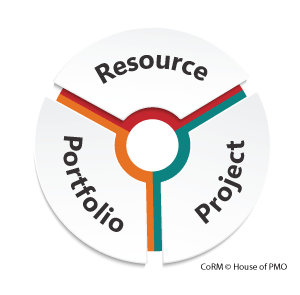 This two-day specialist course helps PMO professionals take the ideas and practical solutions from the House of PMO Inside PMO Report on Resource Management and turn them into practical action. It is designed to help delegates make sense of resource management in their own organisation, identify where the biggest issues sit, and leave with realistic improvements they can start applying straight away.
Using the Circle of Resource Management (©CoRM), the course explores three connected areas: Project, Resource and Portfolio. Delegates look at how PMOs can improve visibility of work and utilisation, support better conversations about skills and capability, and help leaders make clearer prioritisation decisions when demand exceeds capacity.
The course is practical throughout, with real PMO scenarios, peer discussion, templates, techniques and action planning. Delegates will work through how to spot resource pressure earlier, challenge unrealistic demand with evidence, support fairer trade-off conversations, and identify what “good enough” resource management could look like for their organisation.
By the end of the two days, delegates leave with a clearer diagnostic view of where their organisation is now, a practical improvement plan, and more confidence to support resource decisions with evidence and judgement.
What You Need to Know
 Learning Approach:
Classroom & Virtual Classroom
 Duration:
2 days
 Virtual Course Timings:
9am to 4:30pm UK time each day
 Price:
Pilot Price – £950 + VAT (includes pdf course materials)
Future Virtual Classroom Courses – £1175 + VAT (includes printed course materials)
House of PMO Individual and Corporate Members receive an exclusive discount. Log into your account to receive £250 off.
| Looking to bring the Resource Management and the PMO course in-house? Get in touch here! |
This course is for PMO professionals who are involved in resource, capacity, capability or portfolio decisions – especially where the PMO is expected to provide insight and influence, without directly owning the people.
It is a good fit if you are being asked to:
- provide clearer visibility of who is working on what
- support resource, capacity or utilisation reporting
- help resolve competing priorities or resource conflicts
- bring evidence into prioritisation conversations
- support capability, skills or workforce planning discussions
- influence delivery decisions when demand is greater than capacity
Typical delegates include:
PMO Analysts
For those supporting resource reporting, gathering data, producing evidence packs, spotting pressure points and helping make resource issues visible.
PMO Managers
For those facilitating resource conversations, managing competing priorities, supporting delivery decisions and helping teams move from opinion to evidence.
PMO Directors and senior PMO leaders
For those influencing portfolio choices, governance, capability planning, executive conversations and decisions about what the organisation can realistically commit to.
Experience needed
There are no formal prerequisites.
Delegates will get the most from the course if they have some experience of PMO, project delivery, portfolio delivery or organisational resource challenges.
This is a practical, discussion-led course, so real-world experience helps.
Virtual classroom training takes place with a live instructor throughout the online course and you will be learning alongside other virtual learners – you’ll be able to see and hear them too!
All you need for virtual classroom training is a decent broadband connection, a webcam and a microphone [Test your setup here]
You’ll receive:
-
- PMO Learning Delegate Workbook
Events
-
-
Resource Management and the PMO
Learning Approach: Virtual Classroom
Duration: 2 days
Virtual Course Timings: 9am to 4:30pm UK time each day
Price: Pilot Price – £950 + VAT
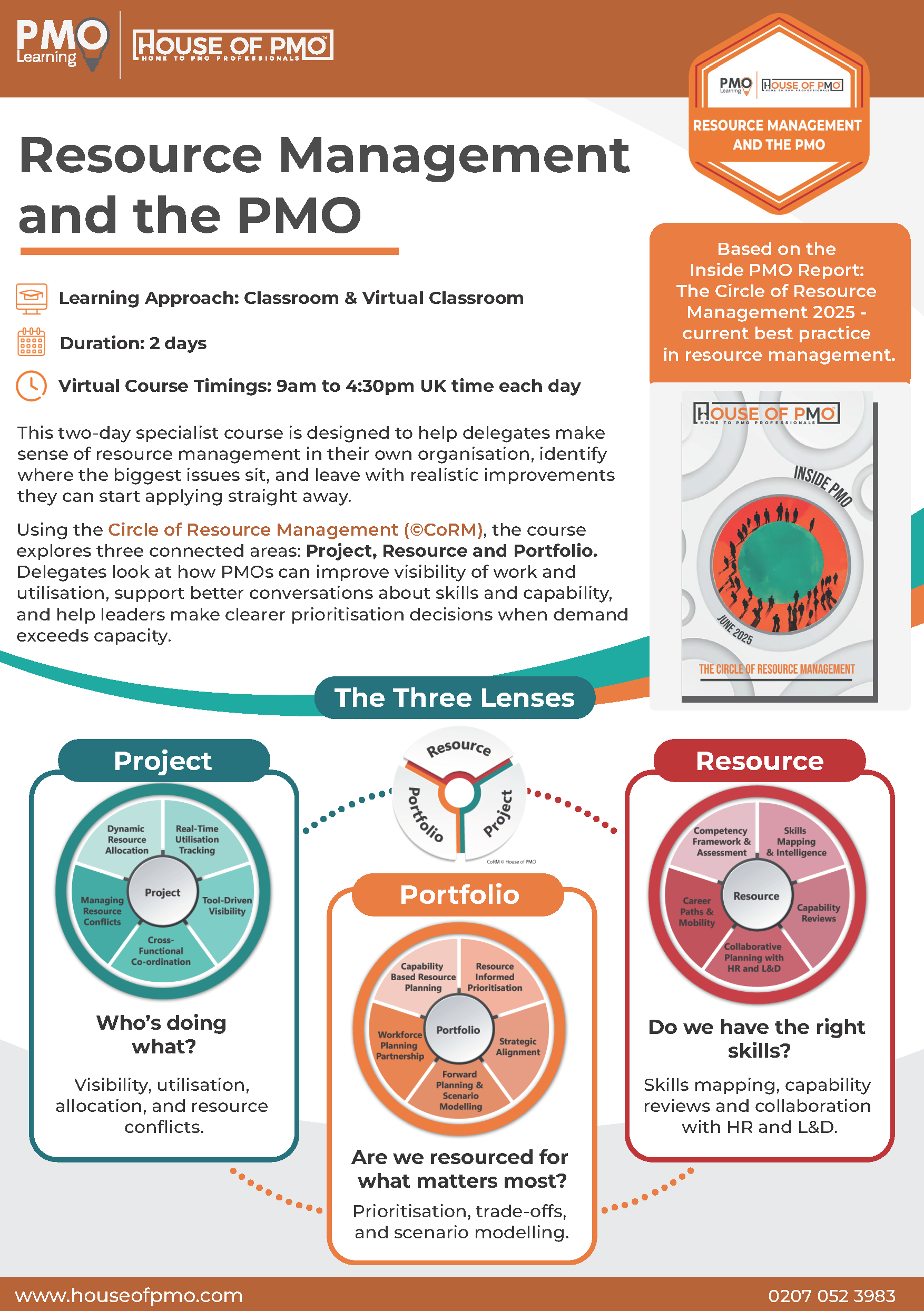
The Circle of Resource Management (CoRM©)
Course Objectives
By the end of the course, delegates will be able to:
- Recognise why resource management is so difficult to get right in PMO environments, and why the same issues keep showing up across projects, portfolios, teams and functions.
- Use the Circle of Resource Management to understand how project demand, resource capability and portfolio priorities affect each other.
- Improve visibility of resource demand, utilisation, allocation and conflict without creating heavy reporting or unnecessary admin.
- Identify where skills, capability or workforce gaps could affect delivery, and how the PMO can work more effectively with HR, L&D and resource owners.
- Support better prioritisation and trade-off conversations when demand is greater than available capacity.
- Use scenario thinking to help leaders understand choices, consequences and delivery risk before decisions are made.
- Identify practical improvements that can be introduced back in their own organisation, starting with small, credible actions that build trust and show PMO value quickly.
In the Course
In the course, learners will cover four areas:
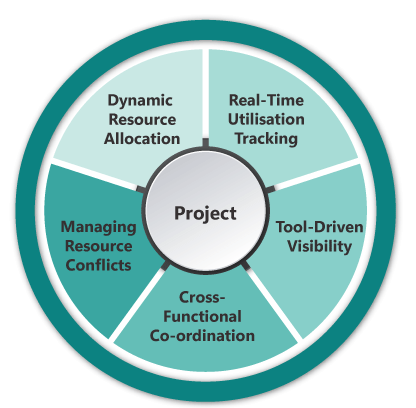
Module 1: Project: Who’s Doing What?
The course begins by setting the context for resource management and introducing the House of PMO Inside PMO Report on Resource Management and the Circle of Resource Management (CoRM).
Resource pressure often shows up first at project level.
This module looks at how PMOs can improve visibility of who is working on what, where capacity is stretched, and where resource conflicts are starting to affect delivery.
Delegates explore how to provide useful resource insight without drifting into task-level micromanagement or creating unnecessary reporting.
Focus areas include: utilisation, allocation, resource conflicts, project-level visibility and PMO judgement.
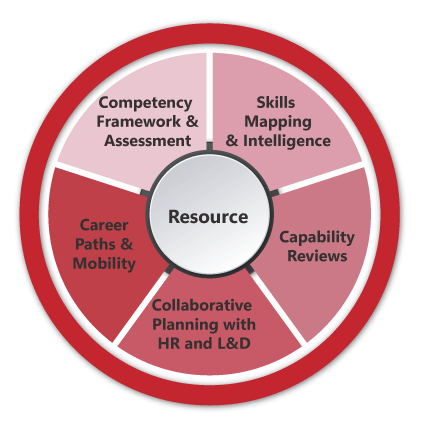
Module 2: Resource: Do We Have the Right Skills?
Availability is only part of the story. This module moves the conversation from how many people we have to what capability we actually need.
Delegates explore how PMOs can support better insight into skills, future demand, capability gaps and resource risk.
The module also looks at how the PMO works with HR, L&D, line managers and delivery leads – influencing the conversation without needing to own everything.
Focus areas include: skills mapping, capability insight, future demand, resource risk and collaboration across functions.
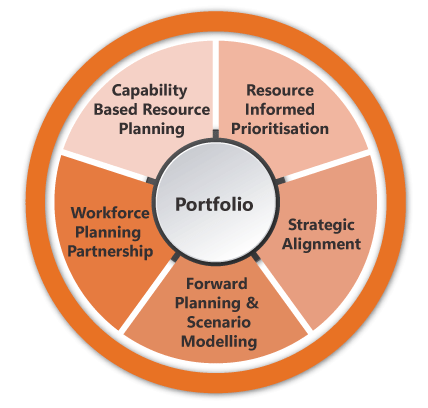
Module 3: Portfolio: Are We Resourced for What Matters Most?
Day 2 lifts the conversation to portfolio level. When demand exceeds capacity, leaders need to make choices. This module looks at how PMOs can support better prioritisation, scenario thinking and trade-off conversations.
Delegates explore how to make constraints, choices and consequences visible so decisions are based on evidence – not optimism, noise or whoever shouted loudest.
Focus areas include: prioritisation, scenario modelling, sequencing, trade-offs and executive decision-making.
Module 4: Joining the Circle and Roles: Turning Insight into Action
The final module brings the Project, Resource and Portfolio areas together.
Delegates explore how resource conversations connect in practice, what happens when they become disconnected, and where the PMO can add the most value.
The focus is on practical application: diagnosing the biggest pain points, understanding the PMO’s role at different levels, and identifying small improvements that can be introduced back at work.
Focus areas include: applying the Circle of Resource Management, PMO role clarity, practical action planning and building trust through visible improvements.
After the Course
By the end of the course, delegates will be able to take a more confident and practical role in resource management conversations.
They will leave able to:
- explain the Circle of Resource Management and how the Project, Resource and Portfolio areas work together
- identify where resource management is breaking down in their own organisation, and where the PMO should focus first
- improve visibility of demand, allocation, utilisation and pressure without creating heavy reporting
support fairer, more evidence-based resource conflict conversations - distinguish between availability, capacity, capability and suitability when discussing resources
- contribute to skills mapping, capability planning and resource risk conversations
- work more effectively with HR, L&D, line managers and delivery stakeholders
- support portfolio prioritisation by making constraints, trade-offs and consequences clearer
- prepare better options and recommendations when demand exceeds capacity
- create a realistic action plan for improving resource management back in the workplace
What Next?
Resource management does not sit in isolation. Once delegates have started to build better visibility, capability insight and portfolio conversations, they may want to strengthen related areas of PMO practice.
For those looking to continue with specialist PMO training, the next useful courses could include Assurance for PMO Professionals or Lean-Agile PMO, depending on the challenges their PMO is currently facing.
For those looking to build broader PMO capability or gain formal certification, our certification routes include the Essentials suite, P3O® certifications and Management of Portfolios®.
For organisations wanting to improve resource management as a team capability, we can also provide bespoke training, workshops or development pathways tailored to your PMO context.
Not sure what the right next step is? Contact us and we’ll help you work out the best fit.
Keep the conversation going
Resource management is one of those PMO challenges that improves through shared practice, not one-off learning. House of PMO membership gives you access to the wider PMO community, research, events and resources to keep developing your thinking after the course.