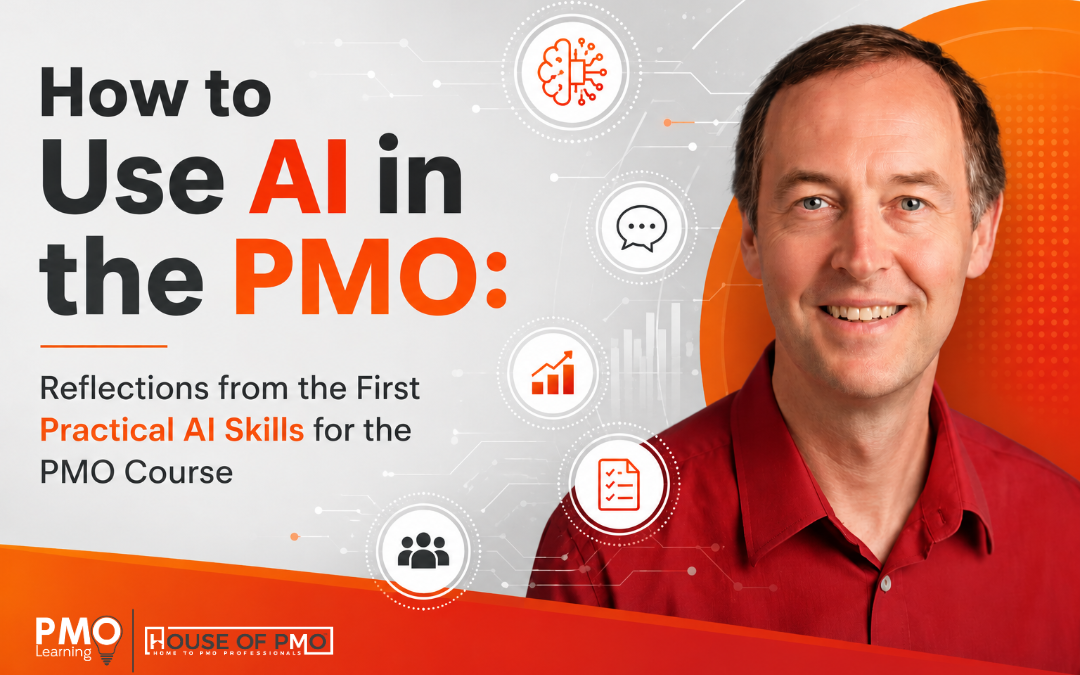
Our Practical AI Skills for the PMO course has now been delivered for the first time, and we asked our trainer Mike, to share some reflections on the experience.
“Delivering the first Practical AI Skills for the PMO course was a fascinating experience. Every new course teaches you something, not just about the content but about how people think, where their challenges lie and what excites them most.
As a trainer, my primary goal wasn’t just to teach people how to use ChatGPT to write faster emails; it was to fundamentally change how PMOs operate, moving them away from administrative “PMO Theatre” and transforming them into strategic, predictive partners.
By the end of the workshop, I could see that shift beginning to happen. Delegates weren’t just asking, “How do I use AI?” They were asking, “How could this change the way our PMO operates?”
What Resonated Most with the Delegates?
The energy in the virtual classroom was incredible, and a few specific concepts really created those lightbulb “Aha!” moments:
- The Multi-Persona Decision Council: This was undoubtedly a crowd favourite. Delegates loved learning how to use AI as a “contrarian sparring partner” to stress-test their project plans. We watched them feed the Skyline Tech relocation case study into the AI and force eight different executive personas, from the Cynical Steering Group Lead to the Optimistic Finance Director, to debate its feasibility. It proved how AI can simulate a brutal 360-degree executive review before a project ever leaves the dock.
- Shifting from Lagging to Leading KPIs: During the Predictive KPI lab, delegates realised how often PMOs rely on metrics that only report a failure after it happens. Learning how to prompt the AI to design predictive, leading indicators, like vendor lead-time consumption, was a game-changer for many who want to build early-warning systems for their portfolios.
- The “Find, Understand, Act” Framework: Delegates found it incredibly helpful to frame AI not just as a text generator, but as an analytical engine that can sift through messy, unstructured data (like meeting transcripts) to uncover hidden dependency chains and root causes.
Evolving the Course: What’s Next?
Continuous improvement is the heartbeat of any good PMO, and based on the brilliant feedback from our first cohort, we are making some exciting upgrades for the next run:
- Reducing Information Overload: In our pilot, we noticed that AI has a tendency to be overly verbose, which leads to reading fatigue during exercises. For the next course, we are baking strict output constraints directly into the Prompting 101 foundation. We will be teaching delegates how to mandate rules like “Format to 300 words max” in their system instructions so they get punchy, executive-ready insights instead of walls of text.
- Fewer Monologues, Deeper “Master Labs”: We are consolidating our numerous short exercises into deeper “Master Labs.” After generating their AI outputs, delegates will immediately jump into Zoom breakout rooms in pairs to compare their results. This peer-to-peer debriefing will help them spot AI hallucinations and share the best prompt structures with each other.
- The “Two LLM” Challenge: To prove that no single tool is perfect, we will be running side-by-side comparisons where one delegate uses ChatGPT and their partner uses Google Gemini on the exact same complex PMO prompt. Seeing the contrasting styles and logic paths will be a fantastic learning experience.
- Building Real-World Artifacts: Finally, we’ve completely redesigned the second afternoon to function as a hands-on build workshop. Rather than just doing exercises, delegates will spend their final hours building their own Personal Context Portfolio (PCP) markdown files. This means they will leave the course with a deployable toolkit that instantly teaches any AI their specific PMO governance rules, team structures, and strategic constraints, eliminating the frustrating “Context Repetition Tax” back at the office.
The first course proved that PMO professionals are hungry to move beyond administrative administration and leverage AI for true strategic impact. I cannot wait to welcome the next cohort and see what we build together!”
Our next Practical AI Skills for the PMO workshop takes place on 10th and 11th August, and we’re looking forward to welcoming the next group of PMO professionals.
Over two interactive days, delegates will learn how to apply generative AI confidently and responsibly within a PMO environment. The course combines practical demonstrations, hands-on workshops and real PMO scenarios, ensuring that everything learnt can be taken back into the workplace immediately.
By the end of the workshop, delegates will be able to:
- Explain what generative AI can and cannot do in a PMO context.
- Apply AI safely within governance, assurance and confidentiality boundaries.
- Use AI to improve reporting quality, insight detection and portfolio visibility.
- Apply AI across planning, risk, resourcing and delivery activities.
- Design AI-enabled PMO services, standards and workflows.
- Build reusable prompt patterns for consistent PMO outputs.
What the course covers
The workshop is structured around four practical learning areas that show how AI can be applied across every aspect of modern PMO practice.
1. AI Foundations & PMO Fundamentals – Understand what AI can and cannot do in a PMO, explore tools such as ChatGPT, Gemini and Microsoft Copilot, and learn how to use AI safely, ethically and within governance boundaries.
2. AI Across the PMO Lifecycle – Discover how AI can enhance governance, reporting, portfolio insights, resource management and PMO service design, helping teams move from reactive reporting to proactive decision support.
3. AI for Project Delivery – Learn practical techniques for using AI to support planning, risk management, meeting outputs, status reporting and day-to-day project delivery activities.
4. Practical Use Cases & Hands-On Application – Apply everything you’ve learnt through real PMO scenarios, building reusable prompts and practical outputs that can be taken straight back into the workplace.
If you’re ready to move beyond using AI for simple productivity tasks and start applying it to the real challenges faced by PMOs, we’d love to welcome you on the next course. Whether you’re supporting projects, programmes or portfolios, you’ll leave with practical techniques, reusable prompts and greater confidence in applying AI safely and effectively within your organisation.
Click here to read more and reserve your place!