 Every now and again you come across something from the PMO archives that makes you stop, partly because it brings back memories of how we used to talk about PMO, but mainly because you realise that some of the conversations we were having years ago are remarkably similar to the ones we are still having today.
That happened recently when I found the photographs and slides from a Resource Management Masterclass we ran back in 2015.
At the time, resource management had been identified as one of the biggest challenges facing PMOs, so the session brought PMO practitioners together to talk about what was making it so difficult, what better resource management might actually look like and, importantly, what they realistically thought could change.
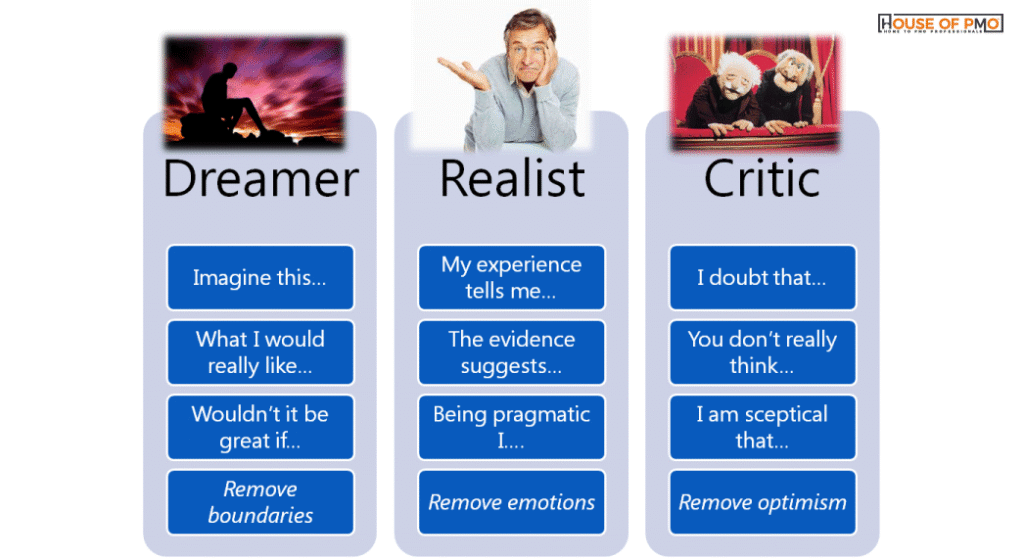
One of the exercises asked people to think about the future of resource management from three different perspectives:
- the Dreamer, who could imagine what good might look like without worrying too much about the barriers;
- the Realist, who brought experience and evidence into the conversation;
- and the Critic, whose job was to question whether any of it would actually work.
Looking at those flipcharts again, more than a decade later, is fascinating because some of their predictions were optimistic, some were wonderfully cynical, and quite a few were uncomfortably accurate.
What did the Dreamers want?
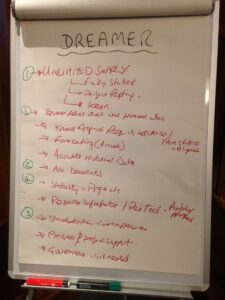
What is interesting about the Dreamer conversations is that people were not really asking for anything particularly fantastical.
They wanted a clear view of BAU and project capacity, better forecasting, resources who were a good fit for projects, more stability around priorities, better data integrity and an easier way of finding the skills they needed when they needed them.
There were also hopes for a bigger resource pool, better reporting and the ability to understand resource demand early enough to actually do something about it, rather than discovering halfway through delivery that the people or skills everyone assumed would be available were already committed somewhere else.
Read that list today and it doesn’t sound like a wild vision of the future, in fact, it sounds very much like the conversation many PMOs are still trying to have.
We want to know what work is coming, what people are already committed to, where the pressure points are, whether we have the capabilities we need and, when there simply isn’t enough capacity to do everything, which work should take priority.
The technology around us has certainly moved on since 2015, yet those fundamental questions haven’t disappeared because resource management was never really just a technology problem in the first place.
The Realists were perhaps the most interesting
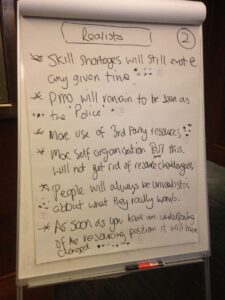
The Realist groups were asked to put optimism to one side and think about what experience told them was likely to happen, and this is where things start to feel particularly familiar.
They thought organisations would continue to use spreadsheets. They expected there would never quite be enough resources, or enough of the right skills, and that demand would continue to exceed what organisations could realistically supply.
They expected skills shortages to remain, believed resource profiling would continue to be important and thought that organisations would still struggle with realistic planning because the information needed to support it would often be missing.
One group wrote that the PMO would be asked to play a role in resource management, but would probably be more involved in co-ordination than real influence, which might be one of my favourite observations from the whole exercise because it gets right to the heart of a challenge many PMOs recognise.
The PMO can be expected to provide the resource picture, identify conflicts, highlight the consequences and keep the process moving, while the actual decisions about people, priorities and investment sit somewhere else in the organisation.
Another Realist comment simply said that people would always be unrealistic about what they really want.
Some things really do stand the test of time.
Then we let the Critics loose
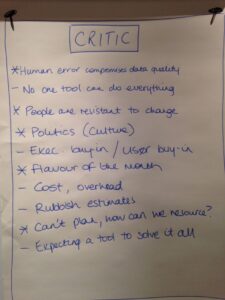
If the Realists were cautious, the Critics had very little interest in making anyone feel better.
Human error would compromise data quality, no single tool would ever be capable of doing everything, people would resist change, politics and culture would continue to get in the way, executives and users would still need to buy into the approach, estimates would remain unreliable, and organisations would keep expecting technology to solve problems that were, in reality, much bigger than the tool itself.
There was also a very simple challenge written on one of the sheets:
“Can’t plan, how can we resource?”
That gets straight to an issue which is easy to overlook when resource management becomes a conversation about systems, utilisation percentages and allocation. If the organisation doesn’t have a sufficiently credible view of the work it is trying to deliver, the priorities keep moving, estimates cannot be relied upon or new work keeps arriving without anything else stopping, there is only so much a resource management process can compensate for.
A sophisticated resource tool sitting on top of unrealistic plans simply gives you a more sophisticated view of an unrealistic plan.
So, have we actually made any progress?
It would be easy to look at those photographs and conclude that nothing has changed, resource management was difficult in 2015 and it is still difficult today, so perhaps the Realists and Critics won. I don’t think that is quite the story.
When the House of PMO revisited resource management with practitioners in 2024 and 2025, many of the underlying problems were still there, but the way PMOs were talking about them had developed considerably.
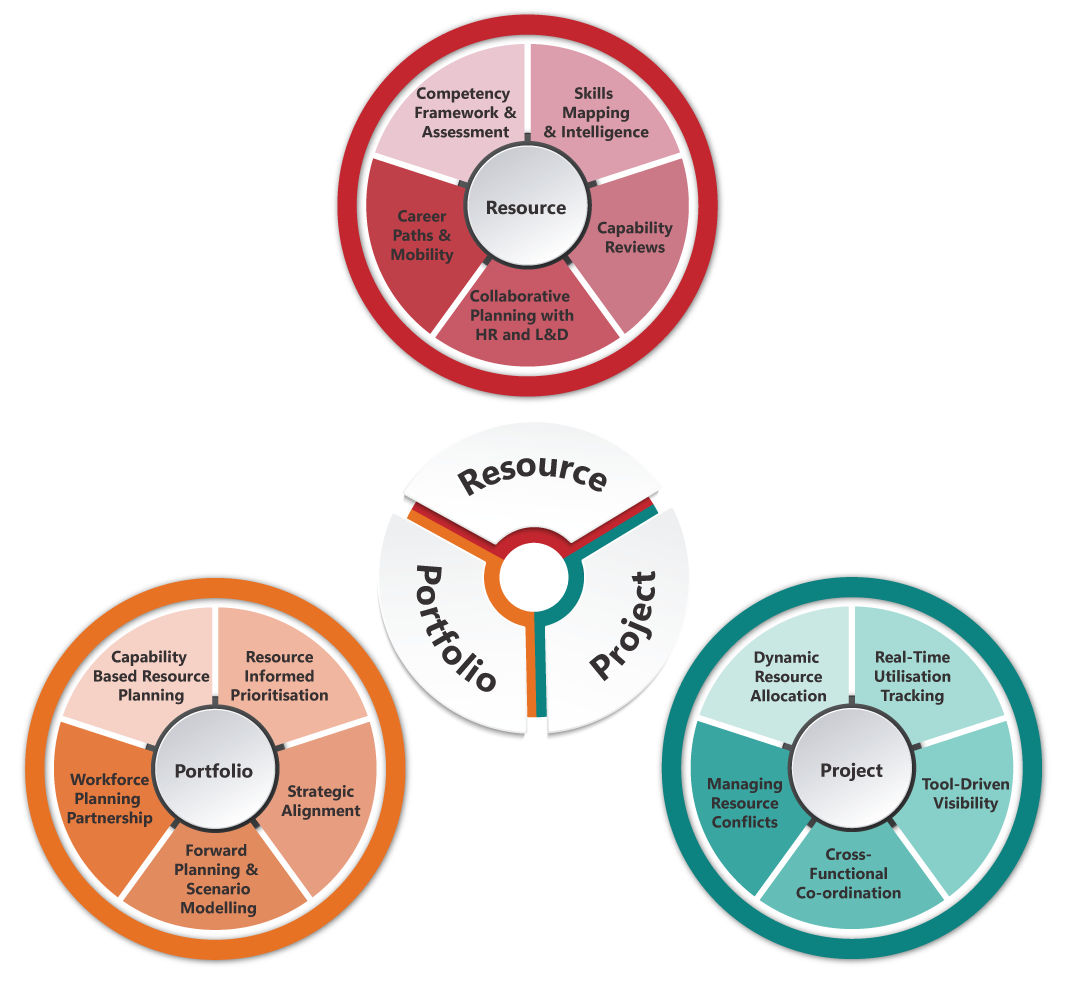
The updated Circle of Resource Management still recognises that effective resource management depends on several connected areas working together, rather than treating resource allocation as an isolated process.
Today we look at the challenge through three connected lenses.
- The Project Lens asks who is doing what, where resource pressure is building, where utilisation is becoming unrealistic and where conflicts are starting to affect delivery.
- The Resource Lens moves beyond the number of people available and asks whether the organisation actually has the right skills and capabilities, where expertise is concentrated, what capability might be needed in the future and where development, recruitment or greater mobility might be required.
- The Portfolio Lens steps back further and asks perhaps the hardest question of all: are we using the capacity and capability we have on the work that matters most?
Around those three areas sit the organisation’s context, culture and capability, because the quality of the process will only get you so far if the wider environment makes honest resource conversations difficult.
That feels like one of the biggest developments in our thinking since those 2015 flipcharts.
Resource management is not something that gets fixed by finding the perfect spreadsheet, introducing a new system or collecting increasingly detailed timesheets, because the hardest parts often involve choices, behaviours, organisational boundaries and conversations that people would sometimes rather avoid.
The PMO’s role has changed too
Another thing that stands out from the 2015 session is that concern about the PMO being involved without having much influence. That question hasn’t disappeared, but the opportunity for the PMO has become much clearer.
The PMO does not necessarily own the people, and in many organisations it shouldn’t, but it can help make the reality of delivery visible so that the people who do own the decisions can make better ones. At project level that might mean showing that the same specialist has quietly been allocated across several projects and BAU activity at the same time. At resource level it might mean showing that an apparently healthy pool of people actually contains a capability risk because only one or two people possess a particular skill. At portfolio level it might mean showing that three individually sensible projects cannot all begin next month because they depend on the same limited capability.
None of those situations is solved by reporting the problem more enthusiastically. The value comes from making the constraints visible early enough, bringing evidence into the conversation and helping decision-makers understand the available choices and their consequences.
Perhaps the Dreamers weren’t dreaming big enough
There is something else I like about looking back at the exercise now, much of what the Dreamers wanted was better information: clearer forecasts, better data, better reporting, greater visibility and easier access to resources. Those things still matter, but perhaps today we would push the Dreamer conversation further.
What would it look like if an organisation became genuinely comfortable saying we do not have the capacity to do all of this?
What if prioritisation meant genuinely choosing, rather than ranking everything from one to twenty and then starting all twenty? What if capability planning was connected directly to the work expected over the next few years, instead of skills shortages appearing as an unpleasant surprise once projects had already been approved? What if resource information wasn’t primarily something the PMO produced for a report, but something leaders routinely used when deciding what the organisation could credibly commit to?
That, for me, is where the resource management conversation has moved.
The objective is not perfect resource management, I am not entirely convinced such a thing exists! It is about having enough visibility, enough credible information and enough organisational honesty to make better decisions before resource problems become delivery problems.
From a 2015 masterclass to Resource Management and the PMO
 Finding these old flipcharts has also been a useful reminder of why we wanted to create a dedicated Resource Management and the PMO course.
The questions PMOs were asking in 2015 have not gone away, but we now have more research, more practitioner experience and a much better way of understanding how the different pieces fit together.
The course uses the Circle of Resource Management to look at the challenge across the Project, Resource and Portfolio lenses, helping PMO practitioners diagnose where their own resource problems are really coming from, improve the visibility they provide and contribute more confidently to conversations about capacity, capability, prioritisation and trade-offs.
It is deliberately not a course about implementing the perfect resource management system, because our 2015 Critics would quite rightly have had something to say about that!
Instead, the focus is on what works in real organisations, what “good enough” resource management can look like for your particular context, where the PMO can genuinely add value and what practical changes you can start making without waiting for the whole organisation to suddenly become perfectly mature.
The first public Resource Management and the PMO course takes place on 5 and 6 October 2026.
Find out more about Resource Management and the PMO
And perhaps before you do, take another look at those 2015 flipcharts and ask yourself the same question we asked then:
Are you a Dreamer, a Realist or a Critic when it comes to resource management in your organisation today?