Portfolio-level resource management tends to become difficult when several perfectly sensible initiatives all need the same limited pool of people, often at roughly the same time. Taken individually, each project may look achievable and each sponsor may have a credible case for moving ahead, but once those demands are viewed together, the question changes from whether the work is worthwhile to whether the organisation can realistically deliver all of it with the capacity and capability it actually has.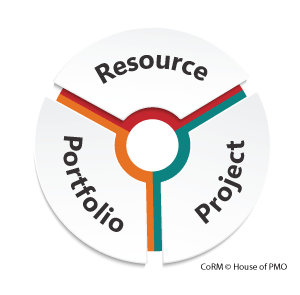
This is the third and final blog in our series exploring the Circle of Resource Management and the three connected lenses within it: Project, Resource and Portfolio. In the first blog, we looked at the Resource Lens and the move from headcount towards skills, capability and future demand. You can read the Resource Lens blog here. In the second, we explored the Project Lens and how better visibility can help PMOs identify resource pressure and conflicts earlier. You can read the Project Lens blog here.
The House of PMO revisited the original Circle of Resource Management with PMO practitioners during 2024 and early 2025, leading to the publication of the updated Inside PMO Report: The Circle of Resource Management in June 2025. Within the updated model, the Portfolio Lens brings together capability-based resource planning, resource-informed prioritisation, strategic alignment, workforce planning and forward planning through scenario modelling.
Having looked at where pressure is appearing through the Project Lens and whether the organisation has the capability it needs through the Resource Lens, the Portfolio Lens takes us to the point where choices have to be made about what the organisation can realistically deliver.
When there is more demand than capacity
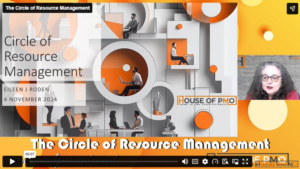
During the Circle of Resource Management webinar, Eileen Roden describes the portfolio-level conversation as being about:
“have we got enough people to do the work that’s in the portfolio?”
She then develops that point by looking not only at the number of people available, but the type of people and skills the organisation has to work with.
This is where the Portfolio Lens starts to expose problems that may not be obvious when projects are considered individually.
Three projects might each have a reasonable plan, a committed sponsor and a strong business case, but if all three need the same technical specialist, business analyst or operational team during the same period, something has to give. That constraint may not appear clearly until the projects are already under way, at which point the options tend to be more expensive, more disruptive and much harder to negotiate.
Portfolio resource management therefore needs to happen before every initiative has become a fixed commitment.
House of PMO Individual and Corporate Members can watch the full Circle of Resource Management webinar here, where Eileen explores the Portfolio, Project and Resource areas and the practical challenges sitting behind each part of the Circle.
Resource reality needs to be part of prioritisation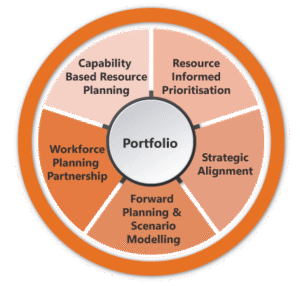
Portfolio prioritisation usually includes strategic alignment, value, risk, benefits and regulatory or operational need, but those considerations only tell part of the story if nobody has tested whether the organisation can actually resource the resulting portfolio.
A project may be important and still not be sensible to start next month.
The updated Circle places resource-informed prioritisation alongside strategic alignment and capability-based resource planning because the availability of people and skills needs to influence decisions about timing and sequencing, rather than being treated as something to sort out once the project has already been approved.
For the PMO, this might mean showing that several high-priority initiatives depend on the same capability, that BAU commitments leave considerably less capacity for change than the portfolio assumes, or that an apparently achievable plan only works if the same people are allocated across several initiatives at once.
The conversation then becomes less about whether a project deserves to happen and more about when it can realistically happen alongside everything else.
Forecasting does not have to be exact to be useful
One of the harder parts of the Portfolio Lens is looking far enough ahead to spot future constraints when much of the work is still uncertain. A project starting next month may have named resources and a detailed plan, while something expected to begin in nine months may still be at concept stage. Trying to resource both with the same level of precision does not make much sense.
In the webinar, Eileen talks about forecasting across three, six and twelve-month horizons and using high-level approaches such as T-shirt sizing to understand broadly what different projects are likely to require before detailed plans exist.
That is an important distinction for PMOs because useful forecasting is not about pretending we know exactly who will be doing what next April. It is about understanding enough of the likely demand to see where pressure might appear and where action may be needed.
If several future initiatives are likely to need the same scarce capability, that is useful information even if the exact dates and names are not yet known. It may be enough to start developing people internally, begin recruitment, protect some capacity or rethink when different pieces of work are expected to begin.
Sometimes the answer is sequencing, not more people
When resource pressure appears, it is tempting to assume that the answer must be additional resource, but recruitment, contractors and external support are not always available, affordable or quick enough. Sometimes the better option is to change the shape of the portfolio.
A project may start a quarter later so that a specialist team can finish something else first, two initiatives might be phased differently so their peak demand does not happen at the same time, or leaders may decide that one piece of work needs to pause because continuing everything would stretch the organisation beyond a credible level.
This is why forward planning and scenario modelling sit within the Portfolio Lens.
Rather than presenting one plan as though it is the only possible answer, the PMO can help leaders compare options and understand the consequences of each one. If one project moves, what capacity does that release? If everything continues, where is the likely pressure point? If something is delayed, what does that mean for benefits, dependencies and risk?
Those are more useful conversations than repeatedly reporting that the organisation is short of resource without identifying what can actually change.
This is where the three lenses come together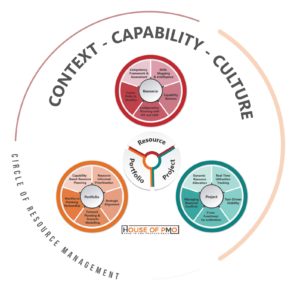
The Portfolio Lens depends on having useful information from the other two lenses underneath it.
The Project Lens helps the PMO understand where people are already committed, where utilisation is becoming unrealistic and where conflicts are emerging. The Resource Lens adds the capability picture, showing what skills exist, where expertise is concentrated and where future gaps may affect delivery. The Portfolio Lens uses those views to support choices about priorities, timing and trade-offs.
Without project-level visibility, portfolio decisions can be based on capacity that is not really available. Without capability insight, the numbers may suggest there are enough people even though the skills required are missing. Without portfolio-level decisions, the PMO can become very good at highlighting the same resource conflicts every month without anything changing.
That interdependence is one of the central ideas behind the Circle of Resource Management. The report deliberately keeps the three areas connected because decisions at one level affect what is possible in the others.
Where does the PMO fit?
The PMO will not usually be the function that decides which strategic initiative should stop or which investment should move down the priority list, but it can make those decisions considerably easier to take.
At portfolio level, the PMO can bring together information about demand, capacity, capability, dependencies and delivery risk so that leaders can see the consequences of the commitments being made.
That may involve presenting alternative scenarios, highlighting where the same scarce people are being assumed across multiple initiatives, or showing that a plan which looks sensible financially becomes much less credible once resource constraints are included.
The value is not in telling leaders that resources are constrained, most already know that. The value is in helping them understand what choices are available because resources are constrained.
Taking the Portfolio Lens further
The Resource Management and the PMO course develops this thinking through practical work on prioritisation, scenario modelling, sequencing, trade-offs and executive decision-making.
Within the Portfolio Lens, delegates explore how PMOs can make constraints, choices and consequences clearer when demand exceeds capacity, so that leaders can make decisions using evidence rather than relying on optimism or allowing every initiative to continue until the resource conflict becomes unavoidable.
The Portfolio Lens is then brought back together with the Project and Resource lenses because effective resource management depends on all three. The Project Lens gives visibility of current pressure, the Resource Lens helps us understand capability, and the Portfolio Lens helps the organisation decide how those limited resources should be used.
Our pilot Resource Management and the PMO course takes place on 5th – 6th October 2026 and is designed for PMO Analysts, Managers and Directors who are already involved in resource, capacity, capability or portfolio conversations and want a more practical way to understand where the problems sit and how the PMO can support better decisions.
At portfolio level, good resource management is not about finding a way to squeeze every approved initiative into the plan. It is about helping the organisation understand what it can realistically deliver, where the constraints sit and what needs to change when the available capacity and capability cannot support everything at once.