One of the questions we’ve been asked regularly over the years at House of PMO is which PMO qualification someone should take next.
It’s an understandable question. When you’re thinking about progressing your career, gaining a qualification can feel like a sensible step. You’ve got something to work towards, something to add to your CV and, hopefully, something that will open a few more doors.
But I’ve been thinking about whether we’re always starting with the right question. Perhaps rather than asking which qualification to take, we should be asking what we want to be able to do differently afterwards.
It’s a subtle distinction, a qualification might help you prepare for a new role, strengthen your understanding of the one you’re already doing or give you the confidence to challenge how things have always been done.
And sometimes, when you start thinking about the knowledge or capability you want to develop, you discover that another qualification isn’t necessarily the answer.
If you’re working in a PMO, or thinking about starting a career in one, you’ve probably come across a range of different qualifications. From courses designed for PMO Administrators, Analysts, Managers and Directors to specialist training in governance, assurance and resource management, there’s plenty to choose from.
 But before deciding which course to take, there’s another question worth asking: what could gaining a PMO qualification actually do for your career?
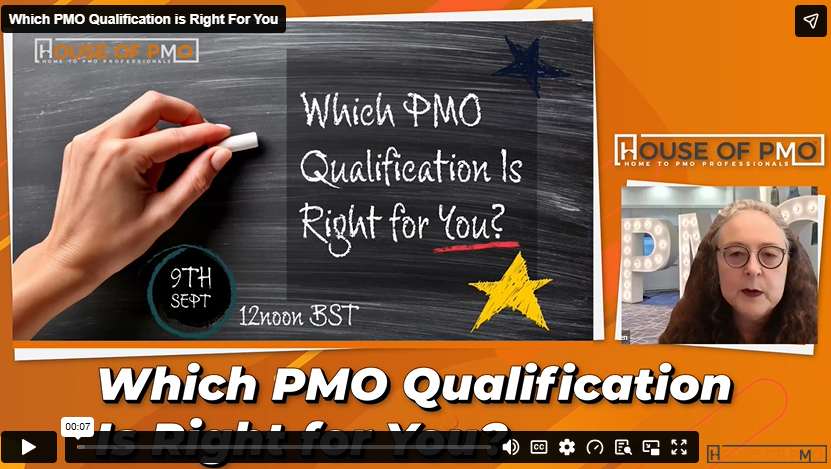
This was one of the topics explored during the recent House of PMO webinar, Which PMO Qualification is Right for You?, where Eileen Roden discussed the different learning routes available and why choosing the right training depends on your experience, responsibilities and career ambitions.
So, whether you’re considering your first qualification or looking to develop your existing skills, what can PMO training offer?
Building Your Knowledge and Confidence
Not everyone enters the PMO profession through the same route. You might have moved from a project delivery role, taken on PMO responsibilities gradually or simply learned through experience.
While learning on the job is valuable, formal training gives you the opportunity to understand the wider principles behind your work and explore how other PMOs operate.
A PMO qualification can help you understand not just what you’re doing, but why it matters, giving you greater confidence to contribute to discussions, question existing processes and suggest improvements.
Something I’ve noticed in conversations with PMO practitioners is that experience and confidence don’t always develop at the same pace. You can have someone who’s spent years producing reports, supporting governance meetings or managing information for projects, yet they’re not always confident explaining why a particular approach works or whether there’s a better way of doing it.
Formal training can help connect those practical experiences to the wider principles of PMO. Suddenly, something you’ve been doing for years has a name, a purpose and a place within a bigger picture.
There’s also the reassurance that comes from discovering other PMOs face similar challenges. The way your organisation does things isn’t necessarily the only way, and what you’ve learned through experience might be more valuable than you’ve given yourself credit for.
Supporting Your Next Career Move

PMO job titles can mean very different things depending on the organisation, which can make it difficult to know what skills you need to develop.
During the webinar, Eileen shared a question she regularly asks people attending training:
“Tell me what your job title is, and then tell me what you actually do.”
I think Eileen’s question gets to the heart of something we’ve been discussing in the PMO community for years.
PMO job titles are wonderfully inconsistent! One organisation’s PMO Analyst might spend most of their time producing reports and analysing delivery information, while another’s could be working closely with senior leaders on portfolio prioritisation and decision-making. Meanwhile, someone with a PMO Manager title might be managing a team, managing a service or running the whole PMO function.
It’s why I’ve always been interested in understanding what people actually do, rather than relying too heavily on the title they’re given.
And it raises an important point about qualifications. Choosing a course based purely on your job title could mean missing the knowledge you need or spending time learning things you’re already perfectly comfortable doing. The House of PMO Essentials qualifications, are designed around four core roles: Administrator, Analyst, Manager and Director, they provide structured learning to help you develop the knowledge associated with your current role or prepare for different responsibilities.
Perhaps the better starting point is to look at your responsibilities today, the areas where you’d like to become more capable and the work you’d like to be doing in a couple of years.
Gaining Recognition for Your Skills
A recognised qualification can also provide evidence of your knowledge and commitment to professional development, particularly when applying for new roles or discussing career progression.
Although a qualification doesn’t guarantee a promotion or new opportunity, it can strengthen your CV and demonstrate that you’ve studied an established syllabus and met a recognised assessment standard.
However, not all valuable training needs to lead to a certificate. Sometimes, developing a particular skill through a specialist course in areas such as resource management, assurance or Lean-Agile PMO may be more useful than completing another formal qualification.
What matters is choosing training that gives you knowledge you can apply in your work.
There’s another side to qualifications that I think is worth talking about.
When someone feels they’re not progressing in their career, it’s tempting to look for another course or qualification. It’s something tangible you can do, particularly when opportunities for promotion or taking on different responsibilities aren’t immediately available.
But I do wonder whether we sometimes put too much emphasis on the certificate and not enough on the experience that sits alongside it.
If you’re already qualified and experienced, would another certificate make the biggest difference to your career? Or would you benefit more from getting involved in a different type of PMO activity, working alongside someone with specialist knowledge or taking responsibility for something you’ve never done before?
I’m certainly not suggesting qualifications aren’t valuable. They’re an important part of professional development. But they’re one part of a much bigger picture, and I think we should be encouraging people to consider all the ways they can develop their capabilities.
Making the Most of Your Training
Completing a course is an important achievement, but the real value comes from what you do with the learning afterwards.
Whether it’s improving a reporting process, introducing a different approach to governance or developing how your PMO manages resources, putting new knowledge into practice helps turn training into lasting professional development.
It’s also worth considering how the learning could benefit your wider PMO, particularly when several members of the team are developing their skills or taking on new responsibilities.
One thing I’d encourage anyone attending PMO training to do is think about what they’re going to try when they get back to work.
Not necessarily a major change or an entirely new PMO process. It might be something as small as asking a different question during a governance meeting, reconsidering how a report is presented or having a conversation with a colleague about a better way to approach an existing problem.
And I’d encourage PMO managers to make space for those conversations too. If someone has spent several days learning about different approaches, surely we should be interested in what they’ve discovered and whether there’s something useful we could try. Otherwise, there’s a danger that someone returns to work with a certificate, some interesting course materials and absolutely no opportunity to do anything differently.
Which seems a bit of a waste of everyone’s time, doesn’t it?
Developing the Skills of Your PMO Team
Are we developing our people for the PMO we have today, or the PMO we’ll need tomorrow?
There’s another question I’ve been thinking about, particularly for people responsible for managing or developing a PMO team.
When we look at training needs, how much of our attention goes towards helping people become better at the work they’re currently doing, and how much goes towards preparing them for the work the PMO might need to do in the future?
It’s an important distinction when you consider how PMO responsibilities are changing. We’re seeing growing interest in data analysis, AI, governance, benefits management and the ability to turn information into something that helps organisations make better decisions.
A team might be perfectly capable of delivering the services expected of it today, but does it have the knowledge and skills to take on different responsibilities as expectations change?
And just as importantly, are we giving individual team members opportunities to develop in directions that interest them, rather than assuming everyone needs to follow the same development path?
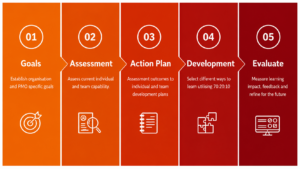
Our PMO Training Needs Analysis (TNA) service helps organisations take a more structured approach to team development. Using a five-stage framework, it assesses existing knowledge and capabilities, identifies individual and collective skills gaps, and supports the creation of development plans that reflect the needs of both the team and the organisation.
Rather than sending everyone on the same training course, the PMO helps organisations identify where different learning opportunities could make the biggest difference, whether that’s formal qualifications, specialist training or other development activities.
Want to understand where your PMO team could benefit from further development? Explore our PMO Training Needs Analysis service.
Where Could Your PMO Training Take You?
Perhaps the answer is that it depends on what you’re hoping to get from it.
For someone new to the profession, a qualification might provide the foundations they need to understand their role and build confidence. For an experienced PMO practitioner, it might offer an opportunity to explore a specialist subject, challenge existing approaches or prepare for a different kind of responsibility.
So before you book your next course, I’d encourage you to think about one question.
What would you like to be able to do this time next year that you can’t confidently do today?
That might be a much better place to start.
If you’re thinking about investing in your own professional development, there are several training routes available depending on your current responsibilities, interests and career ambitions.
The PMO Essentials qualifications focus on the knowledge and skills associated with the four core PMO roles: Administrator, Analyst, Manager and Director, and what you need to know to carry out your role effectively and take on new responsibilities as your career develops.
For those wanting to develop their understanding of governance, the Project, Programme and Portfolio Governance Professional (P3GP) certification focuses on how effective governance supports decision-making and oversight.
Alternatively, if there’s a particular area of PMO work you’d like to develop, our specialist courses cover topics such as AI skills, benefits management, resource management and assurance. The important thing is choosing training that reflects what you want to achieve, whether that’s feeling more confident in your current role, developing a new skill or preparing for your next career move.
Want to explore which qualification might be right for you?
House of PMO individual and corporate members can watch the recent Which PMO Qualification is Right for You? webinar recording and read the blog article, where Eileen Roden explores the different qualification routes and how to choose the right development opportunities for your career. Click here to read more.